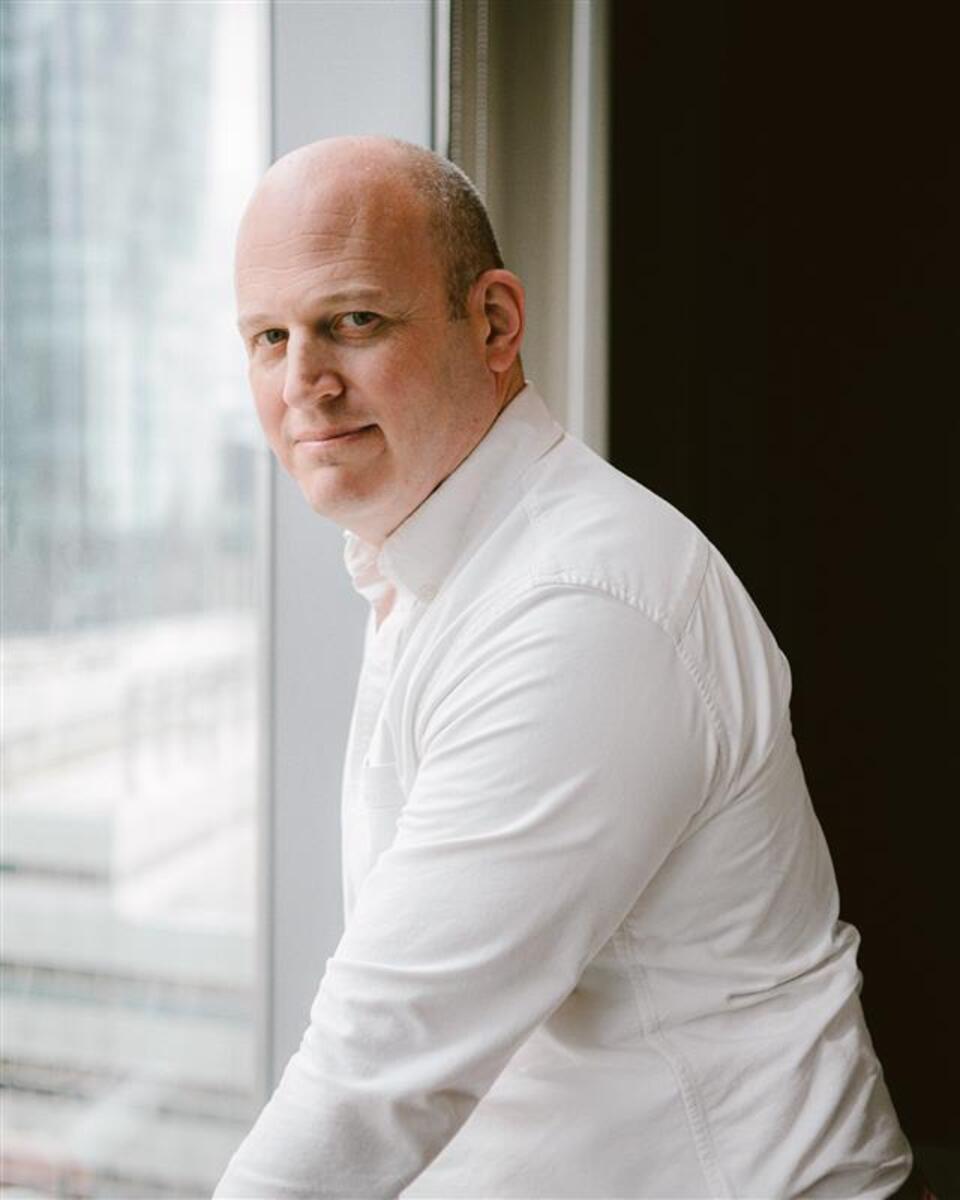

Richard Christiansen with his dogs Daylesford (left) and Freeway (right). Photo: Pia Riverola
Happy Sunday, and welcome to Inc.’s 1 Smart Business Story! Today, we have a fabulous long read for you. While consumer brands are building for speed, scale, and algorithmic performance, Flamingo Estate—the buzzy maker of farm-to-table pantry items and luxurious bath and body products—is taking a refreshing approach: slow things down, make the customer journey feel truly personal, and turn lifestyle into mythology. Flamingo Estate founder Richard Christiansen says he developed this approach in part because “people smell bullshit.”
As Inc.'s Jennifer Conrad reports, Christiansen treats storytelling as infrastructure rather than marketing. He still writes the company’s newsletters himself, he oversees nearly every image tied to the brand, and he obsessively defends the elements that make Flamingo Estate feel like a chic experience. That attention to detail, coupled with a “scaling scarcity“ model, has resulted in a $50 million business.
In this piece, you’ll discover:
How Flamingo Estate turned scarcity and inconsistency into brand curiosity
Exactly how to use emotional storytelling to create a real competitive advantage
What founders can gain by shifting from a philosophy of brand building to one of world building (think Marvel, or Barbie)
The Glamorous Growth Strategy of Flamingo Estate
Richard Christiansen isn’t just selling soap, olive oil, and condiments. He’s built a $50 million business that’s reinventing luxury brand building.
BY JENNIFER CONRAD, SENIOR WRITER
Set high up a winding road in northeast Los Angeles, the 1940s Spanish Revival home is guarded by a tall gate, the house number barely visible. Flamingo Estate is intentionally hard to find. Strangers show up almost daily, hoping to visit, Richard Christiansen tells me on a Saturday morning in early March. The house is not only the home he shares with his fiancé, creative director Aaron Harvey, but also the inspiration and dreamy backdrop for his beauty and pantry staple brand of the same name.
Since it launched during the pandemic, Flamingo Estate has built a cultlike following for its high-end, back-to-nature products: a tomato-scented candle ($64) was an early viral hit, spicy dried strawberries ($82), olive oil made with fruit from a fourth-generation California farm ($48), and handmade bricks of botanical soap ($46).
As Flamingo Estate’s founder and CEO, Christiansen, 49, has set out to create a luxury brand inspired by the city he lives in. Where L’Occitane evokes the south of France, and Sol de Janeiro the beaches of Brazil, Flamingo Estate draws inspiration from Los Angeles’s year-round growing season, the shimmer of celebrity, and a very noisy brand of quiet luxury.
The property—which at times was a vineyard, a goat farm, an adult-film studio, and an artist commune—is central to the brand’s positioning. It’s the kind of place where Pamela Anderson would pop into the kitchen to discuss her great-aunt’s pickle recipe, Martha Stewart would hold a candlelight dinner, or Glossier founder Emily Weiss would host her baby shower—because all of those things have happened here.
“Many of the green brands are so earnest and boring,“ says Christiansen, a former creative director who founded the agency Chandelier Creative. “We have enough to feel bad about. We need to make this fun and part of culture.“
So far, Anderson has made four batches of pickles with Flamingo Estate. “His brain is on fire,” she tells Inc. of Christiansen. “I love being near him.” The proceeds of each drop go to animal charities, such as Save the Chimps and Return to Freedom, a sanctuary for horses and burros. “Wild horses and pickles go together, don’t they?”
Martha Stewart’s dinner at the estate for her beauty line, Elm Biosciences, was meticulously documented in Flamingo Estate’s newsletter and Instagram feed. In an email to Inc., she describes Christiansen as “her friend“ who has “created a veritable paradise … raising bees, extraordinary flowers, and rare chickens, among many other things.” Stewart, who knows a thing or two about building an enduring lifestyle brand, says that Christiansen’s “creativity is boundless.“
But Flamingo Estate wasn’t built on whimsy and celebrity connections alone. Christiansen has created a financially viable brand in a very crowded lifestyle space thanks to effective storytelling and hands-on brand building. Flamingo Estate expects to reach profitability this year, and Christiansen says it brought in $30 million in sales last year. It’s on track to generate $50 million in sales in 2026, and Christiansen expects to hit $75 million in 2027.
Luxury fashion houses have certainly taken notice, and Christiansen says he’s had meetings with many of them. One in particular—a family-owned house he coyly avoided naming—could one day acquire Flamingo Estate.
“I like that they’re looking at the garden and the farm as luxury goods,” says Christiansen. “It’s on our bag: Mother Nature is the last great luxury house.”

Flamingo Estate is located in the hills between the neighborhoods of Eagle Rock and Highland Park. Photo: Courtesy Flamingo Estate
Keep the brand at the center of everything
How does Christiansen intend to preserve what makes Flamingo Estate special while building it into a global brand? Be vigilant about “brand, brand, brand first and only brand,“ he says. “Nothing else.“
Christiansen styles nearly every photo taken at Flamingo Estate, writes every Instagram post, and pens the weekly newsletter, which often features glamour shots of produce, opulent dinner parties, and models bathing. “I will never outsource that stuff,” says Christiansen. “It’s the biggest window to your thoughts and your world.“
Growing up on a farm in New South Wales, Australia, where his parents kept bees and grew sugarcane, Christiansen dreamed of working in the fashion industry and left home at 17. He moved to London and later Italy, where he worked for the fashion brand Benetton and ran its magazine, Colors. In his mid-20s, he moved to New York City, where, in 2004, he founded Chandelier Creative, an advertising agency that worked with major brands including Apple, Old Navy, and Hermès.
It was Christiansen’s childhood experience with bees that initially led him to the property that would become Flamingo Estate. A friend connected Christiansen with the elderly owner who wanted beehives installed on his property. The 80-something gentleman answered the door on their first meeting in a red silk bathrobe and leopard-print G-string.
Christiansen set up the hives, and the two became friends. The owner offered to sell Christiansen the property for whatever he could afford on one condition: no looking inside first. Christiansen bought the house and seven-acre grounds in 2013 for what he describes as the price of a high-end watch. Inside, he found a drained pool and rooms full of detritus from the former owner’s career as an adult-film producer, including one reel titled The Crotch Watcher.
Christiansen set about planting gardens and renovating the house, which he dubbed Flamingo Estate for its pink stucco exterior. In the years that followed, Christiansen grew increasingly burned out from his life in New York, running an agency that, at its peak, had more than 100 employees and offices in three cities. (Chandelier Creative still exists, although Christiansen is no longer involved in its day-to-day operation.)
He started to think about what he’d do if he ever had his own brand. Each company he worked for asked him the same question: How do we act small now that we’re big? “They were too big to be vulnerable, funny, or culturally relevant; they’re too big to be emotional,“ says Christiansen. “Scale just kills all the fun.“
Sid Mathur, a former chief strategy and development officer at Mattel, met Christiansen when he’d relocated to L.A. full time in 2017. He began to think about building a business inspired by the estate. “I had a business thesis and he had a creative thesis that was broadly the same,“ says Mathur, who is now chairman of Flamingo Estate.
Over the past 15 years, with the rise of social media and e-commerce, companies have shifted from a one-to-many relationship to creating what Mathur calls “the illusion of a one-to-one relationship.” It was the era of the DTC boom, and true brand building was giving way to cheap, quick scaling. Large companies struggle to appear innovative, but Mathur thought, what if there were a way to create innovation at scale and package it in a way that might be attractive to a larger company? He calls it “scaling scarcity,“ which is not very different from how luxury-goods brands create demand by limiting access to their products.
Mathur says he brought two lessons from his time at Mattel: The first was that you need to let creatives like Christiansen wander a bit. “If you try to put everything into a box, you won’t have a breakthrough.“ The second lesson was that a consumer business needs to generate gross margins of at least 50 percent to afford the marketing and activations that help a brand grow.

Strawberries from Harry’s Berries, dusted with guajillo chiles. Photo: Courtesy Flamingo Estate
An idea born out of the pandemic
Flamingo Estate was still a concept rattling around in Christiansen’s brain when the pandemic hit. He heard about area farmers who were in danger of losing their businesses because restaurants weren’t placing their usual produce orders. So Christiansen began selling boxes of local produce out of Owl Bureau, an art bookstore he owned in LA. (The storefront is now Flamingo Estate’s office, with a small retail space that’s open on weekends. The produce boxes are still available for delivery.) Soon, farmers began approaching Christiansen about uses for their raw ingredients, and the company branched into candles and pantry goods like olive oil.
If he’d started out thinking he’d be a candle business or a soap business, he might have gone straight to a contract manufacturer. Instead, he still operates the way he did during the pandemic: When he discovers an ingredient he loves, he figures out what to make with it.
The company’s signature “soap brick” was inspired by one of the estate’s most luxurious features: the bath house. It’s a three-story structure with a poured-concrete tub, a fireplace, and blue stained-glass windows overlooking the garden. The water from the tub empties into his garden, and he realized the product he’d been washing with was killing his roses.
Over the past six years, Flamingo Estate’s network of suppliers has grown from a handful of California farms to more than 150 suppliers around the globe, including a collective of women farmers in Bhutan who hand-pick tea leaves and Hawaiian farmers who grow ginger for a limited-edition soap.
“Last week, his team picked up 100 pounds of Zahidi dates,“ Christina Kelso of the permaculture date garden Flying Disc Ranch in Thermal, California, said in early April. “That was a boon for us during our midseason. It is rare for us to get a large order at the Wednesday Santa Monica farmers market.”
Nature as the last great luxury
On paper, Flamingo Estate is a business that shouldn’t work—at least at scale. The company’s focus on seasonality means it moves fast and develops a wide range of products. Early on, the company had close to 150 SKUs.
More than 100 potential investors said no. Among their concerns, the business wouldn’t be able to provide the consistency and predictability that most retailers want. Many said to drop the food business since the margins are higher on beauty products, and customers generally go through a bar of soap faster than a fancy bottle of olive oil.
The investors who got it understood that scarcity and inconsistency could be a feature, not a bug, of the business model. “We rejoice in the inconsistency of wine. It’s different year to year,“ Christiansen says. “Why wouldn’t we do the same with our hand soap if it’s made with natural ingredients?“
The company declined to share exactly how much funding it has raised to date, but said its investors are mostly angel investors and family offices, as well as early-stage investors like Worklife Ventures and Synetro Group. In 2023, The New York Times reported that Flamingo Estate closed a $7.5 million funding round. Christiansen says the company is burning very little cash. “They’ve been very financially responsible as a company,“ says Brianne Kimmel, the founder of Worklife VC. “They don’t overspend.“
Flamingo Estate has about 40 employees on the business and creative side, including Lauren Prince, the COO and former CEO of Chandelier Creative, as well as senior staff members who came from L.A.-based wellness brand Moon Juice and trendy hotel chain Ace. Another 20 or so employees pack and ship the company’s products from a warehouse in L.A. Christiansen’s partner, Aaron Harvey, is the company’s creative director.
Its growth speaks to a world in which beauty, fashion, food, and wellness are increasingly crossing categories, and stores like Sephora and Ulta have begun adding supplements to their offerings. Fashion boutiques are opening cafés. Spanish fashion house Loewe is credited alongside Flamingo Estate with kicking off the tomato candle craze—even Trader Joe’s offers a version now. Dan Barber’s Row 7 sells tinned vegetables as lovely as the tinned fish that took the food world by storm a few years ago. Oishii has proved that people will pay a premium for beautiful strawberries. Meghan, the Duchess of Sussex, has taken a similar path to Flamingo Estate with her pantry goods line As Ever, inspired by her home just up the California coast in Montecito.

Flamingo Estate hand soap comes in custom fluted glass bottles. Photo: Courtesy Flamingo Estate
The touch, the feel of Flamingo Estate
Today, Flamingo Estate’s products are sold mostly direct-to-consumer and there are subscription options that encourage repeat purchases. But wholesale has more than doubled since last year, Christiansen says. Flamingo Estate is distributed at Nordstrom, Bloomingdale’s, Anthropologie, and boutiques around the U.S. In Australia, its products are available at Mecca, a beauty superstore similar to Sephora. In April, Flamingo Estate launched in Japan. The company is developing fragrances—a particularly high-margin category—with Jean-Claude Ellena, the “nose” behind many of Hermès most famous scents. Ten years from now, Christiansen sees Flamingo Estate as the kind of brand where someone racing through an airport can pick up a gift, maybe a soap, a candle, or a bottle of wine.
“It’s a really well-rounded brand in terms of its offerings, and it ticks so many of the boxes of what a modern lifestyle brand should be because it has a foot in fashion, interiors, beauty, and well-being,“ says Sarah Brown, a beauty consultant and the former beauty director of Vogue. “It seems to have been built with a lot of care and intentionality. It’s earthy, grounded, and super chic. It doesn’t have sharp edges.“
Many of the ingredients that go into Flamingo Estate’s products are picked, harvested, stirred, and bottled by hand, Christiansen says. Aside from a few beauty products made by contractors, everything is produced in-house and shipped from the company’s warehouse in L.A.
And someday soon, those strangers who keep showing up at Christiansen’s front door might actually get to touch and smell and experience something of the estate. When we spoke in early March, Christiansen had just put in offers on spaces in Beverly Hills and Pasadena, which he envisions as a complete brand experience, including restaurants and shops for the company’s products. Smaller stores dedicated to candles, fragrance, or pantry items could follow.
“You can’t fake that kind of high-touch personal business,“ he says. “I care so much about everything we make, and I won’t make anything that I don’t use myself. I hope people can feel that. I think people can smell bullshit.”
5 More Smart Business Stories:
“Red Lobster’s Last Gasp” (Bloomberg)
“Big Money is Betting on Bagels” (New York Times)
“He Made a Gadget to Amuse Pets. Then He Turned to Killer Drones.” (New York Times)
Advertisement:
Attio is the AI CRM for modern businesses Ask Attio anything: prep for calls, update records, spot deals at risk Over 4,000 startups including Granola, Wispr Flow, and Lightdash, already use Attio. Try Attio for free.